




Yet HVAC environmental conditions are among the harshest in the electronics industry. Sensors are continuously exposed to condensation, refrigerant airflow, vibration, dust, mechanical stress, and thermal cycling. Traditional epoxy-sealed probes or metal housings have limitations that often lead to failure over time.
To address these challenges, next-generation injection-molded IP67/IP68 waterproof temperature sensors—particularly those using high-precision NTC thermistors—are rapidly being adopted by HVAC manufacturers worldwide. Their monolithic, fully sealed structure offers significant performance and reliability advantages over legacy sensor designs.
This comprehensive technical article explains real market pain points, presents the engineering design principles behind molded HVAC sensors, highlights reliability test evidence, and explores future technology trends that will shape next-generation air-conditioning and thermal control systems.
Temperature sensing has become one of the most critical components in modern HVAC systems. Whether in residential air conditioners, commercial chillers, heat pumps, dehumidifiers, or large air-handling units, accurate and stable temperature feedback determines energy efficiency, equipment safety, and long-term system reliability.
Yet HVAC environmental conditions are among the harshest in the electronics industry. Sensors are continuously exposed to condensation, refrigerant airflow, vibration, dust, mechanical stress, and thermal cycling. Traditional epoxy-sealed probes or metal housings have limitations that often lead to failure over time.
To address these challenges, next-generation injection-molded IP67/IP68 waterproof temperature sensors—particularly those using high-precision NTC thermistors—are rapidly being adopted by HVAC manufacturers worldwide. Their monolithic, fully sealed structure offers significant performance and reliability advantages over legacy sensor designs.
This comprehensive technical article explains real market pain points, presents the engineering design principles behind molded HVAC sensors, highlights reliability test evidence, and explores future technology trends that will shape next-generation air-conditioning and thermal control systems.
Real-World HVAC Challenges: What Causes Temperature Sensors to Fail?
1.1 Constant Exposure to Moisture and Condensation
Inside HVAC evaporators and heat exchangers, water droplets continuously form and fall. Over time, moisture ingress can cause:
· Drift in resistance values
· Short circuits or leakage
· Corrosion of internal leads
· Intermittent or unstable readings
This leads to miscalculations in coil temperature, refrigerant control, and compressor cycling—one of the most common HVAC maintenance issues.
1.2 Thermal Cycling and Rapid Temperature Fluctuation
HVAC sensors must withstand dramatic temperature swings:
· Evaporator coils can drop near freezing
· Condenser coils can rise above 70–90°C
· Outdoor heat pump units face harsh seasonal variations
Repeated expansion and contraction can damage seals, break connections, or destabilize the sensing element.
1.3 Mechanical Stress During Installation
Tight mounting spaces, cable bending, and vibration from compressors or fans introduce mechanical stress. Poor design or weak materials often cause:
· Broken wires
· Deformed housings
· Microcracks in sealing materials
Any of these issues compromise long-term stability.
1.4 Slow Thermal Response Impairs System Efficiency
A temperature sensor that reacts slowly cannot provide timely feedback to:
· Prevent coil frosting
· Optimize compressor operation
· Manage defrost cycles
· Maintain thermal comfort
Modern HVAC systems require sensors capable of delivering fast, repeatable, and noise-free measurements.
1.5 Long-Term Drift and Aging
HVAC equipment is expected to operate for more than 10 years. Many standard sensors exhibit:
· Gradual value drift
· Poor insulation resistance
· Degraded encapsulation due to heat or humidity
These failures often occur post-warranty and directly impact brand perception.
2. The Engineering Solution: Injection-Molded IP67/IP68 Waterproof HVAC Temperature Sensors
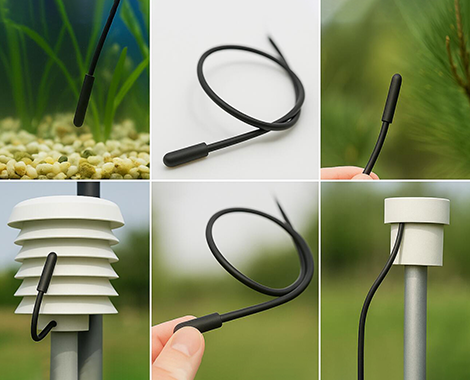
Injection-molded sensors are engineered to eliminate structural weaknesses found in traditional probes. Their fully sealed, uniform housing integrates the cable and sensor head into a single molded piece, providing superior protection and stability.
2.1 One-Piece Injection-Molded Waterproof Structure
Unlike epoxy-filled or two-part housings, the injection-molded design forms a single monolithic structure, ensuring:
· Zero gaps or bonding interfaces
· Excellent mechanical integrity
· Consistent IP67/IP68 waterproof performance
· Resistance to cracking and moisture aging
This significantly enhances lifetime durability even in continuous wet environments.
2.2 High-Precision NTC Thermistor Core
NTC thermistors remain the preferred sensing technology in HVAC because they offer:
· High sensitivity in critical temperature zones (0–70°C)
· Tight tolerance options (±0.1°C to ±0.3°C at 25°C)
· Low noise performance
· Stability over long operating periods
Combined with molding encapsulation, the NTC element becomes both environmentally protected and thermally responsive.
2.3 Optimized Thermal Response Design
Advanced molding enables:
· Thin-walled sensing area for faster heat transfer
· Reduced thermal inertia
· Tight fit on evaporator coils or metal plates
This ensures rapid response to quick temperature changes—essential for compressor protection and frost detection algorithms.
2.4 Cable Durability and Installation Flexibility
HVAC technicians appreciate sensors that:
· Bend easily
· Resist tearing and pulling
· Remain stable after vibration
High-flex cables with reinforced insulation deliver better handling performance and reduce installation-related failures.
3. Application Advantages: What HVAC Manufacturers Gain
3.1 Stable Coil Temperature Monitoring
Accurate evaporator and condenser temperature monitoring prevents:
· Coil freezing
· Overheating
· Inefficient refrigerant flow
· Compressor damage
Molded sensors maintain accuracy even under continuous water contact.
3.2 Improved System Efficiency
Fast and accurate temperature feedback enhances:
· Inverter compressor performance
· Smart defrost cycles
· Thermal comfort stability
· Energy-saving algorithms
This has become a core requirement for today’s high-efficiency HVAC systems.
3.3 Extended Service Life and Reduced Warranty Claims
A robust IP67/IP68 sensor eliminates common moisture-related failures—one of the leading reasons for HVAC component returns.
This results in:
· Fewer field faults
· Lower maintenance costs
· Stronger brand reliability
3.4 Versatility Across HVAC Applications
Injection-molded sensors are widely used for:
· Evaporator coil temperature
· Condenser and discharge line sensing
· Ambient air measurement
· Pipe contact temperature sensing
· Defrost control systems
· Fan and compressor thermal protection
Their adaptability makes them valuable in both commercial and residential HVAC systems.
4. Reliability Evidence: Test Standards Behind HVAC-Grade Sensors
To meet industry expectations, premium injection-molded sensors undergo comprehensive validation.
4.1 IP67/IP68 Waterproof Certification
Testing includes:
· IP67: 30-minute immersion at 1 meter
· IP68: Extended underwater testing for deeper or longer durations
Sensors must show zero leakage and stable electrical readings.
4.2 Thermal Shock and Temperature Cycling
Extreme cycling tests:
· From −40°C to +125°C
· 100–500 cycles
This validates structural integrity and material resilience.
4.3 Heat-Humidity Endurance (85°C / 85% RH)
Simulates years of exposure to condensation inside HVAC units.
Validated sensors demonstrate:
· Minimal drift
· Stable insulation resistance
· No moisture ingress
4.4 Long-Term Drift Testing
Conducted to ensure:
· Stable resistance curves
· Reliability over thousands of operating hours
· Consistent system behavior across the product lifecycle
4.5 Mechanical Vibration and Cable Pull Force Testing
Evaluates durability against:
· Fan vibration
· Compressor movement
· Installation stress
Passing these tests confirms suitability for real-world HVAC environments.
5. Case Study: Improving System Stability in Heat Pump Applications
Heat pumps present special challenges: they operate across wide temperature spans and must frequently alternate between heating and cooling cycles.
Manufacturers who switched to injection-molded sensors reported:
· 50–70% reduction in moisture-related failures
· Faster coil response, improving defrost control
· Greater compressor protection
· More stable field performance in cold climates
This directly translated into higher customer satisfaction and reduced maintenance workload.
6. Market Trends: What’s Next for HVAC Temperature Sensing?
6.1 Smart and Multi-Sensor Modules
Next-generation HVAC systems use multiple sensing inputs:
· Temperature
· Humidity
· Frost presence
· Pressure
Integrated modules streamline installation and improve system intelligence.
6.2 Predictive Maintenance and Onsite or Remote Communication
Stable temperature data is the foundation for:
· Fault prediction
· Energy optimization
· Compressor life modeling
Upgrading sensor reliability directly enhances user feeling performance.
6.3 Miniaturized High-Accuracy Probes
Smaller sensors allow:
· Tighter placement on coils
· Faster heat response speed
· Cleaner hardware designs
This aligns with global trends toward compact, efficient HVAC units.
6.4 Sustainable and Energy-Efficient Designs
Environmental regulations are pushing HVAC systems to be:
· More energy-efficient
· Lower carbon
· Longer-lived
Reliable sensing is essential to meeting these targets.
Conclusion
Injection-molded IP67/IP68 waterproof temperature sensors have become the new industry standard for HVAC applications. Their superior sealing performance, mechanical durability, fast thermal response, and long-term stability address the most persistent challenges faced by HVAC engineers.
By combining advanced NTC thermistor technology with robust encapsulation and rigorous reliability testing, these sensors offer:
· More accurate thermal control
· Improved system efficiency
· Longer equipment lifespan
· Reduced warranty failures
As HVAC systems evolve toward smarter, more energy-efficient architectures, high-reliability temperature sensing will play an even more pivotal role. Manufacturers who adopt these advanced molded sensors today are positioning themselves for a more sustainable, higher-performing future.

Expert for Thermistors Temperature Sensors Humidity Sensors Level Sensors ; Reliable but flexible custom products development
100+ Sensing Solutions Developed Annually for Different Applications
80+ Countries Customers Serviced


